A packaging machine can lose cycle speed, fail to release a clamp, or stop a filling circuit when a valve matches the pipe size but not the pilot pressure, flow requirement, seal material, or fail-safe state. By the end, you will know how external piloting works, how to compare 1-inch and 3/4-inch connections, and what information to give a supplier before ordering.
Key takeaways
- Use separate pilot air when process pressure is low or zero.
- Choose 1 inch or 3/4 inch after checking flow, threads and space.
- Confirm pressure, temperature, seal material and failure position.
- Send port size, media, operating data and circuit function for an accurate quotation.
How external pilot operation controls a 2/2 packaging valve
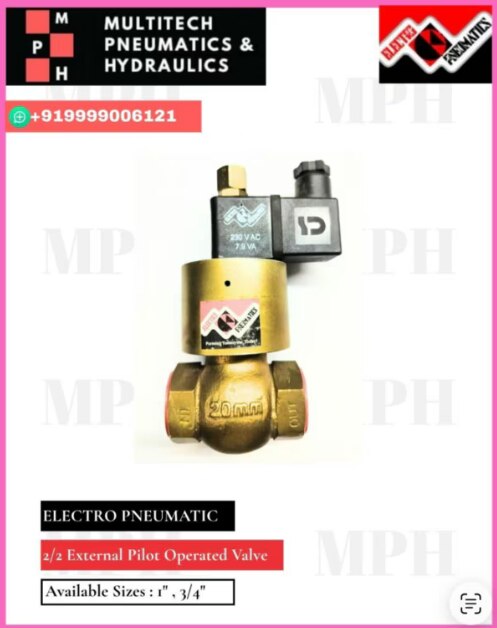
A 2 by 2 external pilot operated valve in Delhi is a two-port, two-position on/off valve. It uses a separate pilot-air connection to move the main sealing element, rather than depending only on pressure at the inlet. That separate supply lets the valve open when process pressure is low or zero.
The pilot signal changes the valve state as follows:
| Pilot condition | Normally closed (NC) | Normally open (NO) |
|---|---|---|
| Pilot air applied | Opens the main passage between inlet and outlet | Closes the main passage between inlet and outlet |
| Pilot air exhausted | Closes the passage and isolates flow | Opens the passage and permits flow |
A solenoid or control valve sends pilot air to the actuator. When the signal is removed, pilot air leaves through the pilot exhaust path, and the spring returns the main valve to its defined resting position. The result is either flow permitted through both ports or flow stopped between them.
Connect the pilot port to a clean, regulated pilot supply, not to the process outlet or an exhaust line. A pressure drop, blocked filter or incorrect connection can leave the valve sluggish or stuck. Confirm the manufacturer’s pilot-pressure range; the main-line pressure rating does not automatically apply to the pilot circuit.
A 2/2 valve isolates flow, while cylinder movement normally needs a 3/2, 4/2 or 5/2 directional valve.
Choose 1 inch or 3/4 inch by flow, thread and installation limits
A 1 inch pilot operated valve is not automatically higher-flow than a 3/4 inch model. The size names describe the nominal connection, while capacity depends on effective orifice, flow coefficient, pressure drop, medium, temperature and port design. Compare the manufacturer’s standard flow or Cv table at your actual inlet pressure and permitted pressure drop.
| Option | What the size tells you | What to verify before choosing |
|---|---|---|
| 1 inch pilot operated valve | Larger nominal connection and possible compatibility with 1-inch pipework | Effective orifice, standard litres per minute, Cv, thread form and body dimensions |
| 3/4 inch pilot operated valve | Smaller nominal connection; not proof of inadequate capacity | Required flow, pressure loss, actual pipe or tube outside diameter and available clearance |
| 3 by 4 inch pilot operated valve | A catalogue or quotation label that must be clarified before ordering | Confirm whether it means 3/4 inch, then verify the drawing and thread specification |
Match the connection to the existing installation without forcing it. “1 inch” and “3/4 inch” do not identify BSPP, BSPT or NPT; parallel and tapered threads are not interchangeable. A wrong thread can leak or damage the valve body.
Send the supplier the required standard flow rate, inlet and outlet pressure, minimum differential pressure, thread standard, pipe outside diameter, valve length, coil clearance and cycle rate. Check the dimensional drawing: an oversized body can obstruct guarding or make tubing bend sharply, while a small internal orifice can restrict a nominally large connection.
Check pressure, temperature, materials and fail-safe behaviour
A valve is safe only when its medium, pressure, temperature, materials and control behaviour match the machine. Air service does not qualify it for water, steam, vacuum or aggressive gases; seal compatibility can fail before the body shows damage.
| Specification | Check | What goes wrong if it is wrong |
|---|---|---|
| Medium | Air, water, steam, vacuum or named gas; confirm body and seal compatibility | Swollen seals, corrosion, leakage or blocked movement |
| Pressure | Inlet, outlet, maximum line pressure, minimum differential and external pilot range | The main valve may not shift, or the body may be overstressed |
| Temperature | Medium and ambient limits at the actual operating cycle | Seals harden, soften or lose their sealing force |
| Fail-safe state | Normally closed or normally open; state after loss of pilot air or electrical power | A stopped machine can continue feeding, venting or filling |
| Construction | Body material, seal compound, exhaust path and mounting orientation | Chemical attack, contamination or an unsafe discharge path |
External piloting lets the main valve operate at low or zero process pressure, but only while pilot air remains within the manufacturer’s stated range. Do not treat the process-line pressure rating as the pilot rating.
Before ordering, confirm these machine-specific figures:
- Response time, cycles per minute and coil duty rating
- Coil voltage, connector type and manual-override design
- Pilot pressure at the valve during the fastest cycle
- Required flow or standard litres per minute, not port size alone
- Manufacturer’s datasheet, dimensional drawing, wiring diagram, pressure-temperature limits and seal material
A valve with the correct 1-inch or 3/4-inch thread can still become the cycle-time bottleneck or overheat during continuous production. Loss of pilot air must also produce the state your machine can safely tolerate.
Match the valve function to the packaging machine circuit
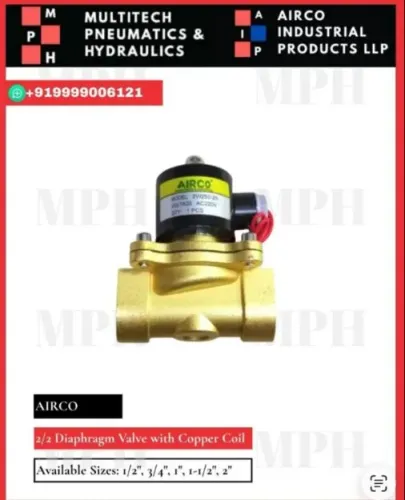
A 2/2 external pilot-operated valve suits simple on/off isolation: it opens or closes one flow path between two ports. Use it for filling-air admission, vacuum isolation, blow-off supply or product-line shutoff, provided the separate regulated pilot supply meets the valve’s pilot-pressure requirement.
| Option | What the machine needs | Suitable valve |
|---|---|---|
| 2/2 external pilot | One flow path switched fully open or closed | Air, water or vacuum isolation; external pilot helps when main-line pressure or differential pressure is too low for internal actuation |
| 3/2, 4/2 or 5/2 directional valve | Flow routed between ports to extend, retract or exhaust an actuator | Pneumatic cylinders, grippers and diverters; a 2/2 valve cannot select cylinder direction |
| Dosing valve | A repeatable quantity or controlled fill rate | Liquid or powder dosing where simple timed opening produces unacceptable variation |
| Proportional-control valve | Flow or pressure changed in response to an analogue command | Speed control, pressure regulation or variable gas delivery; a 2/2 valve provides only open or closed operation |
Use this checklist before specifying the valve:
- Choose a directional valve if the circuit must extend and retract a cylinder, or switch between work and exhaust ports.
- Choose a dosing valve if accuracy depends on metered volume, mass or flow rather than merely starting and stopping it.
- Choose proportional control if the controller sends a 0–10 V, 4–20 mA or similar signal and the process needs intermediate output.
- Retain the 2/2 external-pilot design for isolation duty, and connect its pilot to clean regulated supply air—not the process outlet or exhaust.
Give a Delhi supplier the information needed for a correct quotation
A correct quotation starts with the machine’s actual operating data, not the phrase “pilot operated valve.” Tell the packaging machine valve supplier in delhi whether the replacement controls air, water, steam, vacuum or another medium; an air-rated valve is not automatically suitable for other fluids.
Send these details with photographs of the existing valve and its nameplate:
- Medium, inlet pressure, outlet pressure and minimum differential pressure
- Required flow, such as standard litres per minute, plus the 1-inch or 3/4-inch connection size
- Actual tube or pipe outside diameter, thread standard and available installation space
- 2/2 normally closed or normally open function, and the required fail-safe state
- External pilot pressure range, including whether pilot air remains available when process pressure falls to zero
- Coil voltage, AC or DC supply, electrical connector, response time, cycle rate and duty rating
- Manual override type, exhaust arrangement and mounting method
- Maximum and minimum temperature, body and seal materials, corrosion resistance and compatibility with cleaning chemicals
- Coil ingress-protection rating if the valve faces washdown, condensation, dust or aggressive packaging material
Give Multitech Pneumatics And Hydraulics the machine’s cycle rate and wiring details, not just the port size; a physically matching valve can still slow production or overheat. Ask the external pilot operated valve dealer in delhi to confirm every quoted specification against your existing circuit before ordering.
Related product
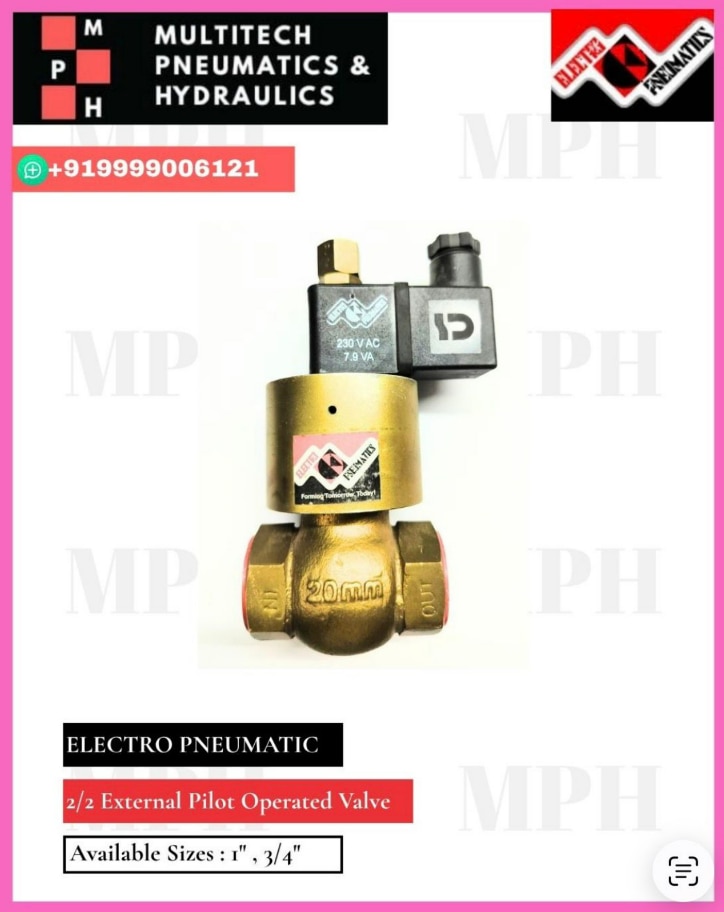 | ELECTRO PNEUMATICS 2/2 External Pilot Operated Valve Available Sizes: 1“, 3/4” ELECTRO PNEUMATIC 2/2 External Pilot Operated Valve Available Sizes: 1“, 3/4” View product → |
Frequently asked questions
How does an external pilot operate a 2/2 packaging valve?
A separate pilot-air connection moves the main sealing element, allowing the valve to open when process pressure is low or zero. The valve has two ports and two positions: open or closed.
Should you choose a 1 inch or 3/4 inch pilot-operated valve?
Choose by required flow, connection thread, available installation space and the machine’s existing pipework. A larger port is not automatically better if the circuit, fittings or mounting space cannot accommodate it.
Which specifications must you check before selecting the valve?
Check process pressure, pilot-air pressure, operating temperature, fluid or gas, body and seal materials, port threads, flow requirement and fail-safe behaviour.
What information should you give a Delhi valve supplier for a quotation?
Provide the valve function, port size, thread standard, media, inlet and outlet pressure, pilot-air pressure, temperature, flow requirement, installation limits and whether the valve must fail open or fail closed.
Keywords