A 5/2 single-solenoid valve can move a double-acting cylinder quickly, but the correct choice depends on its spring-return behaviour, flow capacity, mounting arrangement and response to power or air loss. By the end, you will be able to match the valve to Delhi automation applications, size its ports and tubing, and write a purchase specification that avoids incompatible replacements.
Key takeaways
- Use a 5/2 valve when a double-acting cylinder needs two controlled air paths.
- Choose spring return only when the fail position is safe for the machine.
- Match valve flow capacity, tubing size and controls to the actual cylinder cycle.
- Record ports, voltage, mounting pattern and seal details for reliable replacement.
How a 5/2 single-solenoid valve controls a cylinder
A 5/2 single-solenoid valve gives a double-acting cylinder two possible air paths. The five ports are:
- Port 1, marked P, receives compressed air.
- Ports 2 and 4, marked A and B, connect to the cylinder’s two chambers.
- Ports 3 and 5 exhaust air from those chambers through silencers or exhaust piping.
In one spool position, port 1 connects to port 2 while port 4 connects to port 5. Air drives the piston in one direction. When the solenoid shifts the spool, port 1 connects to port 4 and port 2 connects to port 3, driving the piston back.
The cylinder’s direction depends on which chamber receives supply in each position, not on the port numbers alone.
A single solenoid operates one spool position electrically; a spring returns the spool when the coil is de-energised. That creates a defined valve state after power loss, but it does not automatically guarantee a safe cylinder position. Load, cylinder orientation, friction and restricted exhaust determine whether the rod retracts, extends or stops.
Test the actual loss-of-power response before approving the circuit. A 5 port valve for pneumatic systems is intended for compressed air or an approved inert gas, not hydraulic oil.
Where spring-return valves fit—and where another function is safer
A 5/2 single-solenoid valve suits a Delhi machine when the cylinder needs one defined position after power loss and the sequence can restart from that position. Typical applications include pneumatic grippers, pick-and-place slides, clamping fixtures, conveyor diverters, packaging stations, assembly fixtures and cylinder-operated gates.
Choose the spring-return orientation only after testing the real failure condition. The cylinder’s de-energised position depends on port connections, mounting direction, load, exhaust restriction and loss of air pressure; it is not automatically “fail safe.” Check that shared manifold exhausts and silencers do not create back-pressure that slows release.
| Option | What it means | When it applies |
|---|---|---|
| 5/2 single solenoid | One coil shifts the spool; a spring returns it | Repetitive extend/retract cycles needing a known de-energised state |
| 5/2 double solenoid | Separate coils command each spool position; the spool can retain its last position | Use when the cylinder must remember its last command; avoid it where loss of power must force a defined position |
| 5/3 centre-spring | The spool returns to a centre condition when both coils are off | Use for controlled stopping or holding only after selecting centre closed, centre exhaust or centre pressure; verify leakage and load movement |
| 3/2 valve | Three ports and two positions, usually supplying or exhausting one actuator port | Use for single-acting cylinders, air clamps or pilot signals; it cannot independently drive both sides of a double-acting cylinder |
A centre-closed 5/3 valve does not guarantee mechanical load holding, and centre exhaust can release a clamp. Use a safety-rated isolation or holding arrangement when unexpected movement could injure someone.
Choose flow capacity, tubing and controls for the real cycle
Specify the valve from the cylinder’s air demand, not its port thread. Use the manufacturer’s effective area, Qn, Cv or sonic-conductance data to check bore, stroke time, operating pressure and allowable pressure drop. A larger thread does not guarantee more usable flow: fittings, silencers, tubing and spool passages can restrict the circuit first.
| Condition | Specification decision | Failure if missed |
|---|---|---|
| Cylinder bore and stroke time | Select flow capacity for the required extension and retraction rate | The cylinder reaches the end of stroke late, causing missed cycle times |
| Load and movement | Use one-way throttle-check valves for meter-out control; choose a larger valve only when the pressure-drop calculation requires it | Meter-in control can let an overrunning or vertical load run away |
| Environment | Match seal material, ambient-temperature range and coil IP rating to heat, dust, oil or washdown exposure | Swollen seals, overheated coils or water ingress cause sticking and downtime |
| Control hardware | Confirm coil voltage, connector, PLC output current and manual override type | The valve fits mechanically but will not shift reliably |
Size tubing to the valve and cylinder ports, then test the real load at minimum plant pressure. A spring-return valve’s de-energised position does not automatically hold a cylinder: port connections, orientation, exhaust restriction and gravity determine the result.
Record the 5/2 function, spring-return state, port standard and thread, mounting style, pressure range, flow rating, seal material, temperature range, IP rating and spare-coil availability. For a suspended load, add a rod lock, pilot-operated check, mechanical brake or another risk-assessed holding device.
Sub-base, inline and vertical mounting: match the interface, not just the thread
A 1/4-inch port thread does not identify a replacement. Compare sub base solenoid valve sizes by the valve-to-base interface: ISO 5599-1 size 1, 2 or 3 uses a defined mounting pattern, while compact ISO 15407-style and manufacturer-specific valves use different bolt centres, gasket shapes and port numbering.
Match the valve, sub-base, seals and screws as one assembly.
| Mounting form | Check before ordering | Failure if mismatched |
|---|---|---|
| Sub-base | Interface standard, bolt centres, gasket, inlet and exhaust threads | The valve will not seat or will leak |
| Inline | Port threads, body length, port orientation and tubing clearance | Tubing bends sharply or blocks the next component |
| Vertical or manifold | Station pitch, common supply and exhaust galleries, coil clearance | Adjacent valves collide or cannot be removed |
Measure manifold spacing from valve centreline to centreline, not from the outside edges. Confirm whether ports 2 and 4 face the cylinder, and whether supply and exhaust connections remain accessible after guards, tubing and silencers are installed.
Plan replacement access before building the panel. Leave room to unplug the connector, release the retaining screws and lift one valve without removing neighbouring valves or the manifold. Record the coil voltage, connector, manual override position and spring-return orientation; a visually similar valve with a different interface is not a drop-in spare.
Build a Delhi sourcing specification that survives replacement
A replacement survives only when the supplier receives an interface-and-performance specification, not “5 port valve for pneumatic systems.” Give a single solenoid valve supplier in Delhi the machine’s drawings, existing valve photographs and loss-of-power test result before approval.
- State the function: 5/2, spring-return, required de-energised cylinder position, port numbering, supply pressure range and permitted back-pressure at exhaust.
- Identify the interface: ISO 5599-1 size 1, 2 or 3, another ISO 15407-style pattern, or inline body; include mounting-hole spacing, port standard, thread size, port orientation and manifold spacing.
- Record performance: flow rating, cylinder bore and stroke time, coil voltage and AC/DC type, connector, manual override, seal material, ambient temperature range and IP rating.
- Photograph and measure the original: mounting pattern, coil dimensions, port numbers, spring-return orientation and label. A visually similar valve is not a drop-in replacement.
- Require continuity items: spare-coil part number, seal kit, allowable shared-exhaust arrangement and the supplier’s written confirmation of interchangeability.
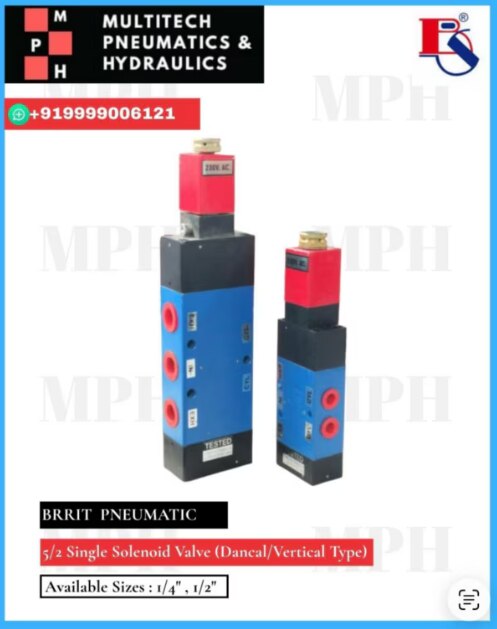
Treat “brrit single solenoid valve” as a model or brand-search term, not a size standard. Multitech Pneumatics And Hydraulics can use this data to distinguish a true replacement from a valve that merely matches the thread. Test the cylinder’s actual loss-of-power position after installation; load direction, exhaust restriction and port connections determine the result.
Related products
 | Airco 5/2 Single Solenoid Valve Available Sizes: 1/8“, I/4”, 3/8“, 1/2” 5/2 Single Solenoid Valve Available Sizes: 1/8“, I/4”, 3/8“, 1/2” View product → |
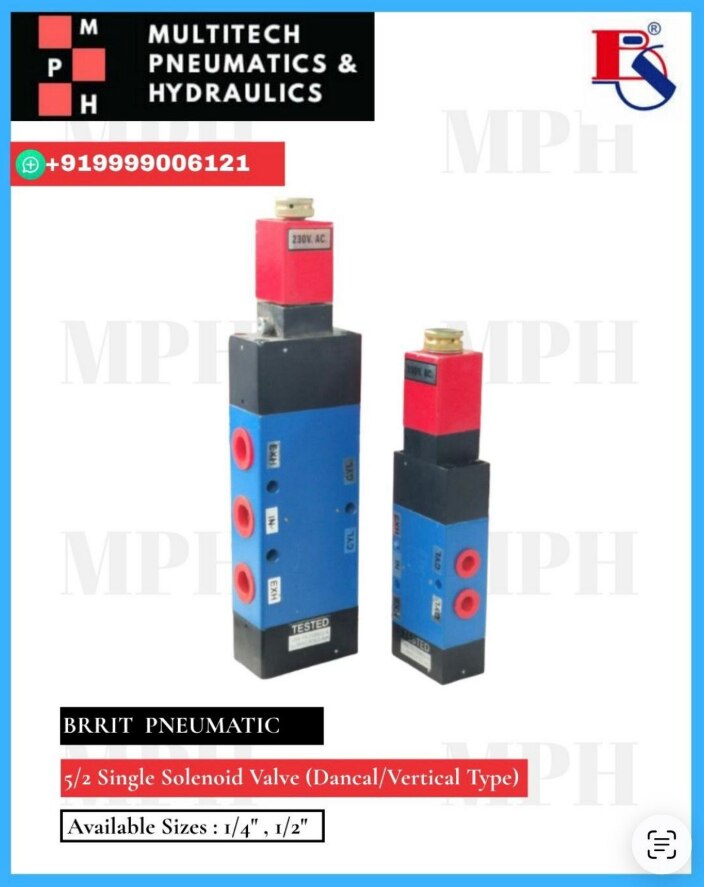 | BRRIT PNEUMATICS 5/2 Single Solenoid Valve (Dancal/Vertical Type) Available Sizes: 1/4“ , I/2” BRRIT PNEUMATIC 5/2 Single Solenoid Valve (Dancal/Vertical Type) Available Sizes: 1/4“ , I/2” View product → |
Frequently asked questions
How does a 5/2 single-solenoid valve control a cylinder?
It switches compressed air between the cylinder’s two working ports while exhausting the opposite side. The solenoid shifts the spool in one direction, and a spring returns it when the coil is de-energised.
When is a spring-return valve suitable?
Use spring return when removing electrical power must produce a defined cylinder position. Select another function when the cylinder must hold its last position or when an uncontrolled return could create a hazard.
How should you choose flow capacity, tubing and controls?
Check cylinder bore, stroke, cycle time, supply pressure and exhaust restrictions. Then match the valve’s flow rating, port size, tubing internal diameter, coil voltage and PLC output to those conditions.
What should a Delhi sourcing specification include?
Record the 5/2 configuration, port thread standard, flow rating, pressure range, coil voltage, connector, mounting style, seal material, manual override and replacement interface.
Related products
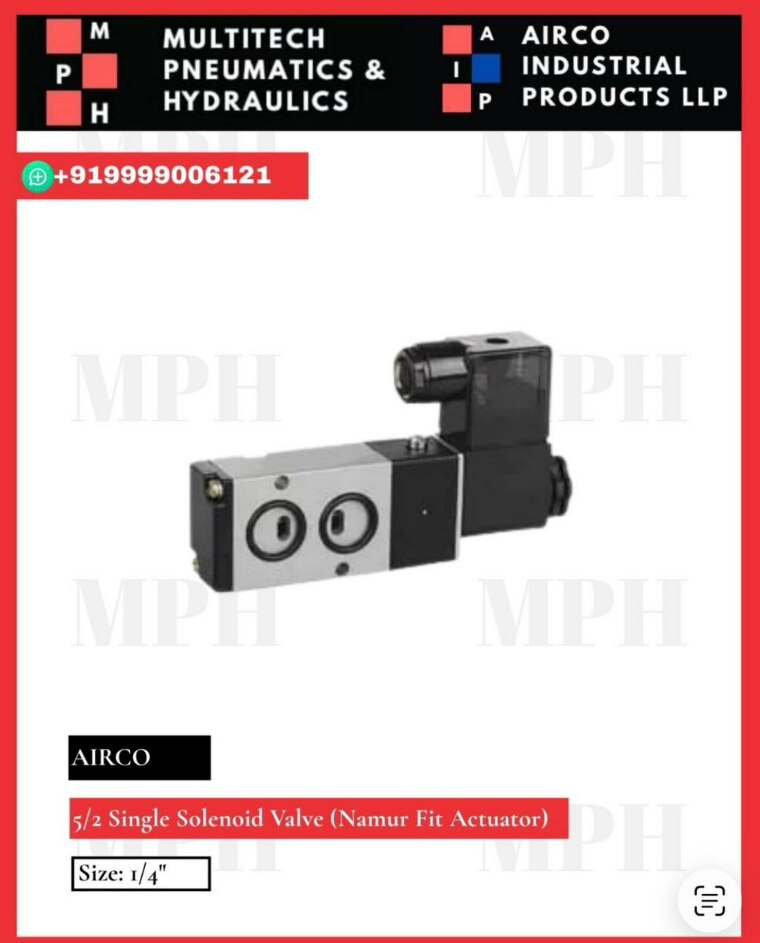 | Airco 5/2 Single Solenoid Valve (Namur Fit Actuator) Size: 1/4" 5/2 Single Solenoid Valve (Namur Fit Actuator) Size: 1/4" View product → |
 | BRRIT PNEUMATICS 5/2 Single Solenoid Valve Available Sizes: 1/4“, 1/2” BRRIT PNEUMATIC 5/2 Single Solenoid Valve Available Sizes: 1/4“, 1/2” View product → |
Keywords