A valve can match the pipe diameter and still fail because its flow arrow points the wrong way, its cracking pressure is too high, or its seal cannot tolerate the fluid. By the end, you will have a specification checklist for comparing valve designs, requesting a quotation, and rejecting an unsuitable substitute.
Key takeaways
- Verify upward flow and vertical installation against the manufacturer’s drawing.
- Match valve size to bore, flow rate and connection standard.
- Confirm pressure, temperature, material compatibility and closing mechanism.
- Specify cracking pressure and reverse-flow control in the quotation.
Confirm That the Pipeline Can Use a Vertical Check Valve
Prove the vertical installation from the piping layout and the valve manufacturer’s drawing before comparing materials or prices. Trace the actual flow arrow: many springless or gravity-assisted designs require upward flow so the disc can close. Downward flow can cause leakage, chatter or failure to reseat unless the drawing explicitly permits it.
Use this site checklist:
- Record the normal and reverse-flow direction at the proposed valve position.
- Confirm that the valve’s permitted orientation matches the pipe route, including any stated vertical, horizontal or arrow-up requirement.
- Measure the available straight-pipe space before and after the valve. Compare it with the manufacturer’s installation drawing; a cramped position can obstruct inspection, removal or stable closing.
- Check whether nearby elbows, tees, reducers or a pump outlet create turbulence that could make the disc chatter.
- Treat “2102” as a model or series identifier, not proof of suitability. Obtain the drawing and verify its bore, connection, orientation and closing arrangement before accepting a substitute.
| Comparison | Suitable evidence | Disqualifying evidence |
|---|---|---|
| Flow direction | Valve arrow points with the intended upward flow | Downward flow prohibited by the drawing |
| Installation position | Required orientation and straight-pipe space are available | Valve must be forced into another orientation |
| Safety function | Line needs reverse-flow prevention only | Suspended load requires load-holding protection |
A check valve is not an isolation valve or safety-rated load holder. A leaking valve can let a pneumatic cylinder or hydraulic actuator move; use a counterbalance valve, pilot-operated check, rod-lock or specified safety arrangement for suspended loads.
This distinction belongs in ss vertical non return valve selection and when specifying a vertical check valve for pneumatic systems.
Size the Valve Against Flow, Bore and Connections
Do not select the valve by DN or NPS alone. Match the valve’s actual bore and connection to the pipe’s inside diameter, then check whether it passes the required flow without excessive pressure loss. A DN25 pipe can have different internal diameters under different schedules, while a valve marked DN25 may have a smaller port.
Collect these sizing inputs before requesting a quotation:
- Fluid and flow rate: state normal, minimum and maximum flow, in L/min, m³/h or Nm³/h.
- Pipe bore: provide the measured or drawing-based inside diameter, not just “25 mm line.”
- Connection: identify BSP or NPT threads, socket weld, butt weld, or flange type, plus size and pressure class.
- Flow performance: request the manufacturer’s Kv or Cv value, pressure-drop curve, and the bore dimension.
- Operating pressure: include pump or compressor pressure and the highest transient pressure.
A check valve with a narrow bore creates velocity and pressure loss; in a pneumatic circuit, excessive cracking pressure can stop a cylinder at low supply pressure. In hydraulics, the resulting back-pressure converts pump energy into heat.
Treat “2102” as a model or series identifier, not proof of size. For stainless steel vertical check valve for selection in delhi, obtain the drawing for the exact configuration and verify that its connections, bore and flow direction match the pipeline.
Ask for the same information when comparing an SS vertical non return valve from another series.
Check Pressure, Temperature, Materials and Closing Mechanism
A body rated for normal pump pressure can still fail when a transient exceeds that rating. Compare the valve’s working and peak-pressure ratings with the highest pressure spike, then check the fluid temperature, steam or hot-water exposure, and the lowest temperature at startup. The seal rating can be lower than the body rating.
| Part to verify | What to confirm | What goes wrong if mismatched |
|---|---|---|
| Body and cover | Stainless grade, pressure rating, and fluid compatibility | Corrosion, distortion, or a pressure leak |
| Disc, guide, and seat retainer | Material of every wetted internal part | A hidden carbon-steel part rusts or contaminates the line |
| Seat and O-ring | NBR, FKM, EPDM, or another specified compound; temperature and chemical limits | Swelling, hardening, leakage, or seat failure |
| Spring and closing assembly | Spring material, disc travel, and permitted mounting orientation | The disc sticks open, closes slowly, or cannot reseat |
For SS vertical non return valve selection, request the complete wetted-parts list rather than accepting “stainless steel” as a material specification. NBR suits much general compressed air; FKM and EPDM have different limits, so check lubricated air, ozone, oxygen-enriched service, and cleaning chemicals separately.
A vertical check valve for pneumatic systems needs a seal and spring matched to the actual air preparation and temperature. A spring-loaded poppet or guided disc must close reliably without excessive force; a leaking check valve is not load-holding protection for a suspended cylinder or actuator.
Use a pilot-operated check, counterbalance valve, rod lock, or safety-rated arrangement for that duty.
Match Cracking Pressure to Flow and Control Reverse-Flow Shock
Cracking pressure sets the minimum differential pressure needed to open the valve. In a pneumatic circuit, excessive cracking pressure reduces cylinder force and can stop movement at low supply pressure; in a hydraulic circuit, it creates unwanted back-pressure, heat and slower actuator response.
Specify pressure drop at the actual operating point, not only the nominal bore. For a vertical check valve for pneumatic systems, provide air flow, upstream pressure, downstream pressure and temperature, then request the manufacturer’s gas-flow data or Cv curve; a Cv value from water testing does not directly predict compressed-air performance.
Hydraulic and water-line selection must use the highest transient pressure, not only normal pump pressure. A valve that snaps shut in a long, high-velocity line can create water hammer and pressure spikes. Ask for closing behaviour, allowable reverse flow and pressure-drop data at your fluid and flow rate.
Match the closing response to the service:
- Pneumatic circuits: use low cracking pressure and low pressure drop where a cylinder must start reliably at reduced supply pressure.
- Hydraulic circuits: control closure to limit shock, while retaining enough sealing force to prevent unacceptable reverse flow.
- Water lines: reject a rapid-closing design if the pipe run, velocity or elevation makes pressure surge a concern.
A check valve is not an isolation valve or automatic load-holding safety device. A leaking valve can let a cylinder or actuator move; suspended loads need a counterbalance valve, pilot-operated check, rod-lock or safety-rated arrangement.
Turn the Selection Into a Complete Delhi Quotation Request
A request for a 2102 vertical check valve in Delhi should identify the service, installation and performance requirements, not just “SS NRV.” Send the same data to every bidder so you compare equivalent valves rather than different constructions carrying similar model numbers.
- Fluid, concentration, cleanliness, flow rate and line size.
- Normal pressure, highest pump pressure and maximum transient pressure.
- Minimum and maximum fluid temperature, including steam or hot-water exposure.
- Required bore, port size, connection type and standard, such as BSP, NPT, socket-weld or flange.
- Flow direction, upward-flow requirement, available straight-pipe length and permitted installation orientation.
- Material grade for the body and every wetted part, including disc, spring, guide, seat retainer and elastomer.
- Cracking pressure, allowable reverse flow, pressure-drop data or flow coefficient, and closing-behaviour information.
- Exact manufacturer part number, dimensional drawing, pressure and temperature ratings, test standard, seal specification, replacement-seal availability and promised delivery of that configuration.
A stainless steel check valve supplier in Delhi should quote the manufacturer’s identifier and attach a traceable datasheet or certificate. For a 2102 valve, match the quotation against the drawing, ratings, bore, connections and wetted materials; confirm the nameplate and packing carry the same part number.
For an alternative, require written confirmation that each field matches. Multitech Pneumatics And Hydraulics is one Delhi supplier to ask for this evidence before approval.
Related products
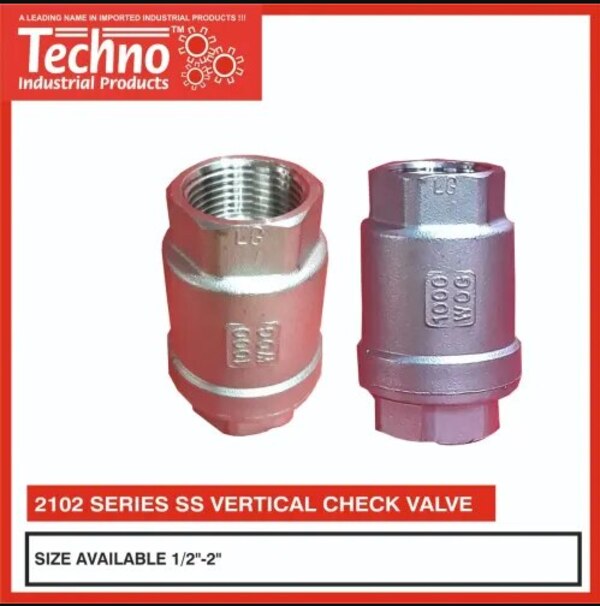
 | Techno 2102 SERIES SS VERTICAL CHECK VALVE Techno The 2102 Series Stainless Steel Vertical Check Valve by Techno is a high-performance industrial valve designed to prevent reverse flow in... View product → |
 | Techno 2102 Series Vertical Check Valve (Techno) – Detailed Information The 2102 Vertical Check Valve (Techno) is a high-quality stainless steel non-return... View product → |
Frequently asked questions
How do I confirm that a pipeline can use a vertical check valve?
Check the piping layout and manufacturer’s drawing, then trace the flow arrow. Many springless or gravity-assisted valves require upward flow; downward flow can cause leakage, chatter or failure to reseat.
How should I size a stainless steel vertical check valve?
Match the valve to the pipeline bore, required flow rate and connection type. Confirm thread, flange or other end dimensions against the existing piping rather than selecting by nominal size alone.
What specifications must I compare before selecting a valve?
Compare pressure rating, operating temperature, stainless steel grade, seal material and closing mechanism. Check compatibility with the fluid and the pneumatic or hydraulic system.
Why does cracking pressure matter in a vertical check valve?
Cracking pressure determines the minimum upstream pressure needed to open the valve. Match it to the available flow pressure, and assess closing speed to reduce reverse-flow shock and water hammer.
Keywords